
Handling long distance caregiving senior parent dynamics is one of the hardest situations a Connecticut adult child can face.
You know how fast a simple phone call can turn from reassuring to alarming when your parent lives in another state.
We see this stress daily at Family Care Connection, a premier provider of senior living referral and advisory services. Those out-of-state families face the highest out-of-pocket costs, averaging nearly $12,000 annually according to 2025 AARP data.
Our team helps Connecticut families bridge the distance, both for parents who haven’t moved yet and for those settled into a local community after an out-of-state move. Here is a breakdown of the exact monitoring protocols, coordination tools, and warning signs that keep out-of-state families informed.
What we monitor on your behalf
After a Connecticut placement, our out-of-town placement work doesn’t end at move-in. Post-move advocacy requires direct action.
We conduct in-person check-ins on a defined cadence to catch problems early. A recent 2026 study in US Medicine found that 39% of senior patients make at least one medication error within just seven days of a hospital discharge.
Our monitoring checklist includes several critical areas to prevent these exact risks:
- Medication-error patterns: Caregivers need verifiable data, so we cross-reference facility logs and often recommend the Medisafe app for remote tracking.
- Social-isolation drift: Observing daily routines ensures your parent is actively engaging with the community instead of withdrawing.
- Weight and dining changes: Unexplained weight loss serves as a major red flag for dining issues or depression.
- Behavioral shifts: Early detection of subtle mood changes allows families to escalate clinical support before a crisis hits.
Adult children three time zones away should not have to rely on a verbal phone update for decisions involving their parent’s safety. We document what we see in writing so you always have a clear, factual record.
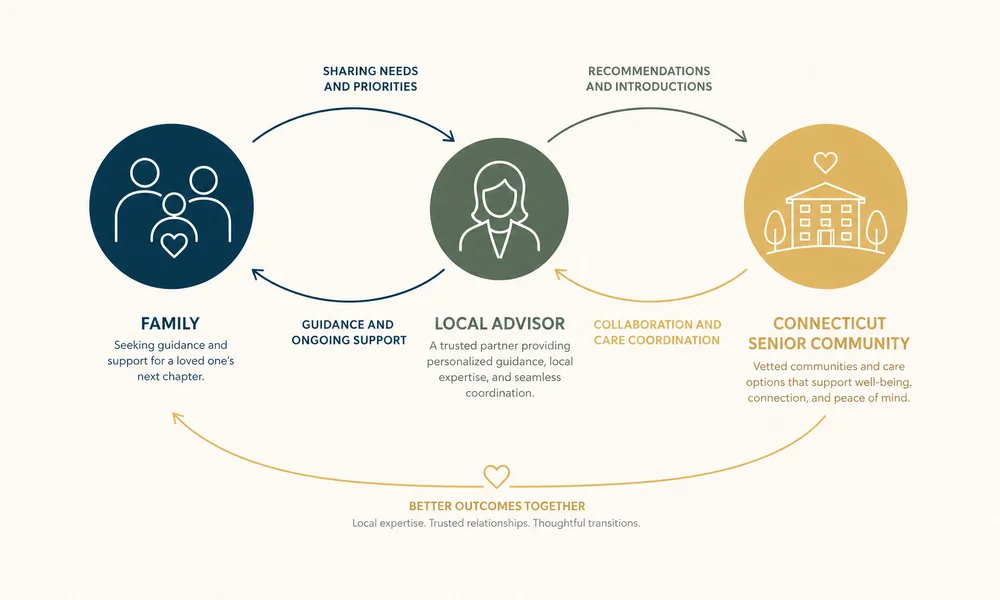
Coordinating with a geriatric care manager
For challenging situations, long distance senior care management requires more than basic advocacy. We often bring in a geriatric care manager (GCM) when a parent has dementia, multiple chronic conditions, or no local family. A GCM adds a critical layer of clinical oversight beyond what standard advisors provide.
Our team looks for professionals certified by the Aging Life Care Association (ALCA) to guarantee the highest ethical standards. These experts attend medical appointments, coordinate directly with the community’s clinical staff, and report back to you.
We find the advisor-and-GCM combination works best for the first six to twelve months after an out-of-state move. The medical picture stays fluid during this adjustment period, so having a licensed nurse or social worker on call prevents emergencies.
| Role | Primary Focus | Typical Background |
|---|---|---|
| Senior Advisor | Facility placement, transition monitoring, and family communication | Eldercare transition specialists |
| Geriatric Care Manager | Clinical oversight, attending doctor visits, and medical advocacy | Licensed nurses or social workers (ALCA certified) |
We can recommend trusted, vetted GCMs across Connecticut and connect you directly. Families should expect the out-of-pocket costs for these local professionals to range between $75 and $200 per hour.
Family-meeting tools that actually help
Family meetings are how remote care coordination senior efforts stay organized. We help families run structured, mandatory family meetings every 60 to 90 days. Without a regular touchpoint, siblings drift into different mental models, creating friction that negatively impacts the parent.
The Structured Meeting Agenda
Our standing agenda covers several critical topics to keep everyone informed:
- Clinical care updates: Reviewing recent doctor visits and medication changes.
- The financial picture: Assessing monthly burn rates and upcoming expenses.
- Upcoming decision points: Outlining what choices need to be made in the next quarter.
- Clear role assignments: Giving specific tasks to each family member so no one gets overwhelmed.
The siblings who live closest aren’t supposed to absorb all the work. We ensure the siblings who live farthest aren’t cut out of decisions because of geography. Top caregiving apps in 2026, such as Caring Village or Lotsa Helping Hands, offer excellent shared calendars and task tracking to keep everyone aligned between these calls.
Our team suggests one simple rule to close out every discussion. Every meeting must end with a written summary detailing the next decision point and who owns it. We ask the designated note-taker to email this summary within 24 hours. Memory blurs fast, so getting facts in writing prevents costly miscommunications later.

Signs long-distance management is no longer enough
The hardest call long-distance families have to make is deciding when remote oversight is no longer adequate. We watch for obvious crisis signals first, such as a hospitalization or a medication error. According to 2024 CDC data, one in four adults age 65 and older falls each year, making physical injury a primary catalyst for changing the care plan.
Our assessments also focus heavily on the subtle decline that happens quietly. Adult children should watch out for a parent answering “fine” to complex questions they can no longer parse, a refrigerator containing mostly expired condiments, or mail piling up unopened. We speak up immediately and provide direct feedback when we see these minor issues stacking up. Sometimes the right response involves scheduling a family meeting to decide which sibling will step in more directly.
Our team does not optimize for a facility move. The goal is always to optimize for what the safety of the situation actually requires. Sometimes the answer is a Connecticut placement, and sometimes it is simply a higher monitoring cadence.
This objective perspective gives out-of-state families genuine peace of mind. We focus exclusively on securing the right level of clinical and daily support to keep your parent protected.
When to call us
If you are an adult child in Connecticut managing a parent’s care from a distance, and you are starting to wonder whether the current setup is sustainable, that is the right time to reach out. We strongly advise families to get help before a medical emergency forces their hand.
Earlier intervention is always easier and less stressful than crisis management.
Our advisory staff is ready to evaluate your specific situation and provide actionable next steps. Reach us at (860) 824-0275 or schedule a free consultation today.